Hydroponic growers depend on water quality to sustain vigorous plant growth and steady yields. Reverse osmosis (RO) systems remove dissolved minerals, chemicals, and contaminants that can hinder nutrient uptake, giving you a reliable starting point for nutrient mixes. The best RO system for hydroponics balances filtration strength, mineral restoration, installation ease, and ongoing maintenance. This guide spotlights five top performers and explains how to choose the right model for your setup, from compact countertop units to higher-capacity under-sink configurations.
In evaluating these systems, key factors include their daily production (gallons per day, or GPD), the number of filtration stages, whether they include remineralization, and ease of maintenance. For hydroponics, you may want a system that can deliver clean water consistently, with options to replenish essential minerals or even produce zero-TE (total dissolved solids) water through a deionization stage. The models below are selected for compatibility with residential hydroponic gardens, hobbyist to mid-sized operations, and ease of integration with common growing media and nutrient regimes.
| Product | Brand | GPD | Stages | Notable Benefit |
|---|---|---|---|---|
| Aquatic Life RO Buddie – 75 GPD | Aquatic Life | 75 | 3-stage | Compact, easy to install for small hydroponic setups |
| Aquatic Life 5-Stage RO System – 200 GPD | Aquatic Life | 200 | 5-stage | High-capacity filtration for larger gardens |
| iSpring RCC7AK – 75 GPD | iSpring | 75 | 6-stage with remineralization | pH-balanced water with added minerals |
| Max Water RO-DI System – 100 GPD | Max Water | 100 | 6-stage (RO + DI) | 0 TDS output after DI stage |
| Home Master HydroGardener TMA-HG-Pro | Home Master | Varies | 6-stage | Remineralization plus adaptability for hydroponics |
Aquatic Life RO Buddie – 75 GPD

The Aquatic Life RO Buddie is a compact, three-stage reverse osmosis system designed for hydroponic use. It provides up to 75 gallons per day, making it suitable for small to mid-sized grow rooms where space is at a premium. This model focuses on reliability and straightforward operation, helping growers maintain consistent water quality without complicated maintenance routines. Its three stages target common dissolved solids and contaminants that can interfere with nutrient solutions, enabling growers to start with a clean baseline for precise nutrition management.
Filtration performance centers on substantial TDS reduction: the RO membrane minimizes total dissolved solids to a ratio of 1 out of 10,000, effectively lowering minerals and impurities that can accumulate in hydroponic water systems. The Buddie’s design favors ease of installation, with standardized tubing and fittings, so you can add it to most under-sink or utility-area setups. For hobbyists cultivating leafy greens or herbs, this unit offers dependable water quality without requiring a large, complex filtration station.
In terms of hydroponics usability, the Buddie pairs well with standard nutrient regimens, as it removes chlorine, chloramines, and other impurities that can skew pH stability and nutrient uptake. While it does not include a remineralization stage, it serves as a strong starting point for growers who plan to add minerals via their nutrient mix after filtration. Regular monitoring of TDS and periodic filter changes keep the system performing optimally.
Aquatic Life 5-Stage RO System – 200 GPD

The Aquatic Life 5-Stage RO System is a high-capacity filtration solution designed for more ambitious hydroponic operations. Delivering up to 200 gallons per day, this unit supports larger grow rooms or multiple tanks without frequent water restocking. The five-stage configuration targets a broad spectrum of impurities, including dissolved solids, chlorine, chloramines, and heavier metals, which can influence nutrient availability and root zone conditions.
What sets this model apart is its comprehensive filter set that typically includes pre-filters, carbon blocks, and RO membranes, plus additional accessories such as canister and membrane wrenches for maintenance. The system’s higher GPD capacity makes it a practical choice for growers who need consistent water production during peak demand periods or for homes with multiple hydroponic projects running concurrently.
Aside from filtration, the system supports hydroponic compatibility by producing water with predictable quality, enabling consistent pH and EC (electrical conductivity) management. The included accessories simplify routine replacements, helping minimize downtime. For serious hobbyists or semi-professional setups, the 200 GPD model offers the reliability to sustain day-to-day operations with fewer interruptions.
iSpring RCC7AK – 75 GPD

The iSpring RCC7AK is a six-stage RO system that adds an AK (alkaline) remineralization stage to deliver water with a balanced mineral profile. Producing up to 75 GPD, this model is positioned as a practical option for hydroponics where mineral balance in the nutrient solution matters. The top-mounted design allows for easy installation above the sink or on a counter, streamlining the setup process in tighter spaces.
The remineralization stage contributes calcium and magnesium to the purified water, helping to maintain a favorable pH and buffering capacity that can support nutrient uptake in hydroponic systems. The system also features a transparent first-stage housing, which makes it easy to observe filter conditions and schedule timely replacements. This visibility aids maintenance planning, keeping downtime to a minimum.
With its six-stage configuration, the RCC7AK covers a wide filtration spectrum, including sediment, carbon, and RO membranes. The combination of thorough filtration and mineral restoration supports growers who want consistently good water for medium- to small-scale hydroponic setups, especially where mineral content in the feed water is variable.
Max Water RO-DI System – 100 GPD
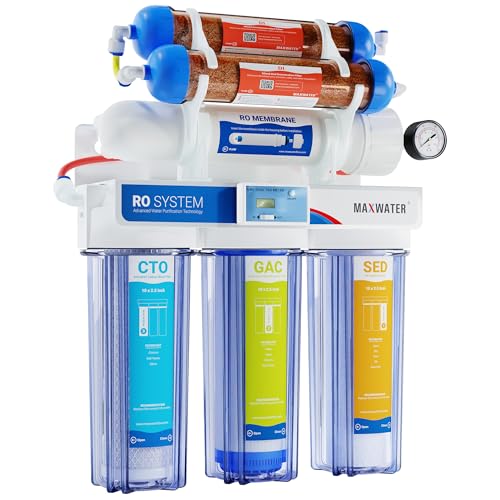
The Max Water 6-stage RO-DI system combines RO filtration with a deionization (DI) stage, delivering up to 100 GPD. The DI stage helps reduce total dissolved solids to very low levels, which is especially valuable for hydroponics that demand exceptionally pure starting water. A notable feature is the built-in TDS meter, allowing growers to monitor water quality in real time and time filter changes accordingly. This model emphasizes both performance and precision in water purification.
Reduced TDS is particularly beneficial when nutrient reliability is critical, reducing the risk of nutrient lockout or pH drift caused by mineral contaminants. Its modular design supports straightforward maintenance and filter replacement, and the color-coded Quick Connect fittings simplify installation. For growers running multiple reservoirs or relying on precise nutrient recipes, the DI-enhanced output can provide a stable baseline from which to build nutrient programs.
While the RO-DI setup excels at delivering ultra-pure water, it is wise to consider the ongoing supply costs for DI resin and replacement cartridges. For hydroponics, this model is well-suited to mid-sized systems that require dependable water quality with low residual minerals and a straightforward maintenance path.
Home Master HydroGardener TMA-HG-Pro

The Home Master HydroGardener is a remineralizing garden-oriented RO system designed to deliver water suitable for hydroponic displays. It emphasizes contaminant removal while ensuring essential minerals are reintroduced through an integrated remineralization pathway, producing water in the range suitable for many hydroponic nutrient regimens. The system is noted for its ability to operate effectively at relatively low water pressures, which can be a practical advantage in some home installations.
Key mineral delivery features add a controlled amount of calcium and magnesium to improve water quality and taste, helping maintain a stable baseline for plant health. The HydroGardener’s design supports straightforward maintenance, with accessible filter housings and clear labeling to guide routine replacement. For growers prioritizing mineral balance alongside impurity reduction, this model provides a balanced approach that aligns with common hydroponic nutrient strategies.
Installation and compatibility considerations include under-sink or utility-area placement, with attention to space for the five- or six-filter assembly. The remineralization approach makes this model especially appealing to growers who prefer to tailor their final water characteristics to their specific crop needs without performing additional post-filtration add-ons.
Buying Guide
Choosing the right RO system for hydroponics involves balancing filtration depth, mineral balance, capacity, and maintenance requirements. Use the following considerations to compare models and align them with your grow setup.
- Capacity vs. demand: Calculate your weekly water needs based on your reservoir size and plant count. Higher GPD systems (like 200 GPD) support larger gardens but require more space and budget; smaller setups can perform well with 75–100 GPD units.
- Stage configuration: Three-stage systems are compact and simple, while five- or six-stage units offer more comprehensive filtration and, in some cases, remineralization or DI capabilities. For hydroponics, ensure the stage setup matches your water quality goals.
- Remineralization vs demineralization: If your nutrient solutions depend on certain minerals, choose a system with remineralization (calcium, magnesium) or plan to compensate in the nutrient mix. DI stages can produce near-zero TDS water, useful for strict water programs but may require more mineral management.
- Water source and pressure: Some units perform best with higher incoming pressure; others are designed to operate at lower pressures. Check your local water pressure and ensure the model you choose can perform reliably in your area.
- Maintenance and filters: Consider the ease of filter replacement, availability of replacement cartridges, and how often you’ll need to service the system. Transparent housings and color-coded fittings can simplify maintenance schedules.
- Monitoring features: Built-in TDS meters or accessible test ports help track water quality between filter changes. This is especially valuable for hydroponics, where precision matters for nutrient uptake.
- Space and installation: Under-sink systems save countertop space but require cabinet clearance and proper routing of tubing. Countertop models or compact units are ideal for small grow rooms or dorm-style setups.
- Waste water considerations: RO systems generate wastewater. If your facility is water-conscious, look for units with efficient waste ratios or plan to reuse drain water where feasible in non-propagation applications.
- Certifications and warranties: Look for WQA or equivalent certifications and manufacturer warranties. These indicators support long-term reliability in a busy growing environment.
Across the five models highlighted here, hydroponic needs range from compact, easy-to-install systems suitable for modest gardens to higher-capacity configurations that support larger operations. If you prioritize mineral balance in your nutrient solutions, prefer remineralization-capable designs, or plan to push total dissolved solids down to very low levels, select a model that aligns with those goals. Regular testing of water quality before nutrient addition will help you refine your approach and maintain consistent plant performance.