Finding the right inline water filter for your refrigerator can mean the difference between bland-tasting ice and crisp, refreshing beverages. This guide highlights five highly compatible inline filters designed to improve taste, odor, and contaminant reduction while fitting common fridge water lines. Read on for quick comparisons, individual product details, and a buying guide to help you choose the best option for your household needs.
Summary of Selected Products
| Product | Brand | Key Benefit | Approx. Lifespan |
|---|---|---|---|
| AQUA CREST Inline Filter (B07Y9S7L29) | AQUA CREST | 5-year/5,000 gallons service life; broad compatibility | 5 years |
| EcoPure EPINL30 | EcoPure | Long-lasting, fits many brands; sediment & taste/odor control | 5 years |
| Waterdrop 15UC-UF (NSF 42/IO) | Waterdrop | 0.01 μm filtration; high capacity | 1,400 gallons |
| Waterdrop PFAS/PFOA Inline (NSF) | Waterdrop | PFAS/PFOA reduction; chlorine & lead considerations | 1,400 gallons |
| GE GXRTLL Inline Filter | GE | Built-in filtration compatibility; easy install | 5 years |
AQUA CREST Inline Filter: 5-Year Capacity

The AQUA CREST inline water filter is designed for refrigerators, ice makers, RVs, and more. It supports 1/4″ direct connect fittings and offers a stated 5-year service life or up to 5,000 gallons, depending on water conditions. The filter aims to reduce taste- and odor-causing compounds and is compatible with many major refrigerator brands. It notes that it does not reduce Total Dissolved Solids (TDS). Installation is described as simple, with both compression and push-to-connect fittings included, along with guidance on proper tube insertion to prevent leaks.
EcoPure EPINL30 Inline Refrigerator Filter

EcoPure’s EPINL30 promises a five-year lifespan and broad compatibility with brands like Samsung, LG, Whirlpool, Kenmore, Frigidaire, and GE. It includes 1/4″ compression and push-to-connect fittings for various water line materials. The design focuses on reducing sediment and improving chlorine taste and odor, aiming to deliver cleaner, better-tasting refrigerator water and ice over a long period.
Waterdrop 0.01 μm Inline Filter System

Waterdrop’s 0.01 μm inline system targets a very fine filtration level, using ultrafiltration media and an activated carbon block. It’s designed for refrigerators, ice makers, and under-sink setups, with a high-capacity claim of around 19,000 gallons and 0.01 μm filtration efficiency to remove many contaminants. It includes 1/4″ direct connect fittings and a note about lead-free, BPA-free materials and coconut shell carbon, with installation guidance emphasizing correct PE tube insertion to prevent leaks.
Waterdrop Inline Filter: PFAS/PFOA Reduction

This Waterdrop inline solution emphasizes NSF-certified filtration to reduce chlorine, PFAS, PFOA, and PFOS, along with lead-free materials and a coconut shell activated carbon block. It provides a robust 1,400-gallon lifespan and uses 1/4″ direct connect fittings with both compression and push-to-connect options for flexibility in plastic or copper lines. The product focuses on improving taste and odor while delivering safer water from the fridge dispenser.
GE Appliances Inline Refrigerator Filter
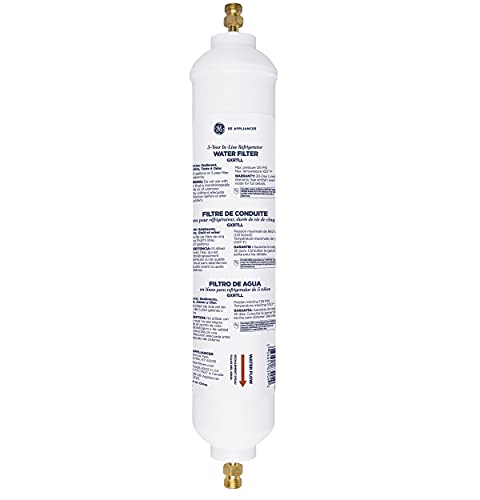
GE’s GXRTLL inline filter is designed to reduce sediment, chlorine, and other impurities in built-in or external filtration configurations. It’s positioned as a straightforward installation for select GE side-by-side and top-freezer refrigerators, including compatibility with units without built-in filtration. The five-year service expectation aligns with low maintenance and ongoing access to improved-tasting water and ice.
AQUACREST Inline Filter: 5 Years / 10,000 Gallons

AQUA CREST’s high-capacity inline filter targets long-term use with 5 years or up to 10,000 gallons of filtration. It emphasizes a broad compatibility range, including common refrigerator brands and models, with 1/4″ direct connect fittings. The media focuses on reducing chlorine taste and odor, bad taste and odor, and general impurities while noting BPA-free and lead-free construction for safety and reliability.
Buying Guide: Key Considerations For Inline Refrigerator Filters
Choosing the right inline filter involves weighing filtration performance, compatibility, and maintenance. Consider the following perspectives:
- Filtration efficiency: Look for NSF/ANSI certifications that verify chlorine taste and odor reduction, lead content limits, and PFAS/PFOA reduction when relevant. Filtration micron size (e.g., 0.01 μm vs. 0.5 μm) indicates different contaminant targets.
- Capacity and lifespan: Filters list service life by gallons or years. For households with high water usage or hard water, a longer lifespan lowers replacement frequency and cost.
- Compatibility and fittings: Ensure the filter uses standard 1/4″ fittings and offers both compression and push-to-connect options for plastic or copper lines. Check that your fridge line is compatible with the filter’s connector type.
- TDS and mineral content: Some filters advertise strong filtration but do not reduce Total Dissolved Solids (TDS). If you rely on mineral-rich water, consider filters that balance taste with mineral retention.
- Installation and maintenance: Favor filters with easy twist-off housings, clear installation instructions, and readily available replacement cartridges. Some models include auto shut-off design for convenient changes.
- Material safety: Choose BPA-free and lead-free materials to minimize any potential leaching. Coconut shell carbon is common in high-quality carbon blocks.
- Cost of ownership: Compare initial price, replacement cartridge cost, and warranty terms to estimate long-term expenses across years of use.
- Impact on taste and odor: Many filters target chlorine taste and odor; for PFAS/PFOA concerns, verify the filter explicitly lists PFAS/PFOA reductions within its certification claims.
- Usage scope: If you need a universal solution, pick filters advertised for multiple appliances (refrigerator, ice maker, RVs) to maximize versatility and value.
Across these options, users should balance capacity, certifications, and compatibility with their refrigerator’s water line. When in doubt, consult the manufacturer’s installation guide to confirm line sizes, adapters, and replacement intervals for your specific model.