Finding a reliable grain mill tailored for brewing beer can improve mash efficiency and consistency. Below are five carefully chosen options designed for malted barley, malted wheat, and other brewing grains. Each selection offers adjustable roller gaps, high-capacity hoppers, and optional drill attachments to speed up the milling process while protecting husks for better sparging. The list focuses on durable construction, ease of use, and suitability for homebrew setups.
| Product | Brand | Hopper Capacity | Key Benefit |
|---|---|---|---|
| FERRODAY Malted Grain Mill – 2 Roller | Ferroday | 7.7 lb | High capacity with drill-ready option |
| Brewland Grain Mill | Brewland | 7.7 lb | Dual milling modes, precise spacing |
| Brewland Grain Mill Pro | Brewland | 15 lb | Large hopper, dual milling modes |
| Northern Brewer Hullwrecker 2-Roller | Northern Brewer | Not specified | All-metal base, precise crush |
| FERRODAY Malt Grain Mill Malt Stainless Steel 2 Roller | Ferroday | 7.7 lb | Stainless steel construction, drill option |
FERRODAY Malted Grain Mill – 2 Roller

The FERRODAY Malted Grain Mill features a large 7.7 lb hopper for bulk milling, enabling multiple batches without constant refilling. Its 2-roller design with 5-inch rollers and 12 TPI knurl pulls grains through while preserving hull integrity to support sparging. The adjustable gap spans from 0.025 to 0.1 inch, letting brewers dial in the desired crush size for malted barley and malted wheat. A drill-ready option exists to boost throughput—use a 3/8 inch, low-speed drill to achieve roughly 7 pounds per minute, depending on grain density. This mill emphasizes durability with stainless steel components and a robust build, ideal for frequent homebrewers seeking efficiency and consistent crush. Note: not suitable for corn, soybeans, flake, or flour.
Brewland Grain Mill
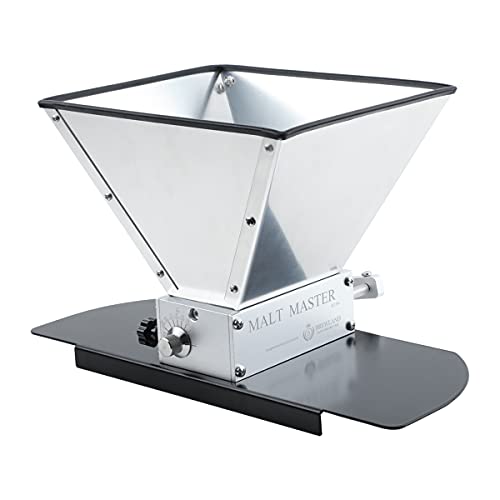
Brewland’s grain mill is designed for precise milling of malt, grain, and barley with an 8-gearcalibration knob that lets you adjust roller spacing from 0.025 to 0.1 inch. This helps release malt sugars while protecting husks. It supports two milling modes: a manual crank for a labor-saving grind, and a low-speed drill option via a 1/2″ or 3/8″ drive shaft with an 8mm hex socket. The 7.7 lb hopper minimizes refilling during longer sessions, improving efficiency for larger batches. It’s explicitly not for corn, coffee beans, soybeans, or sugarcane and cannot produce flour, ensuring a controlled crush for beer craft.
Brewland Grain Mill Pro

The Brewland Grain Mill Pro expands capacity with a 15 lb hopper, enabling larger production runs without frequent loading. It features the same 0.025–0.1 inch roller adjustment, ensuring precise control over crush and husk integrity. The dual milling approach—manual crank or drill-assisted drive—lets brewers scale up efficiency. The Pro model continues Brewland’s focus on reliable housing and bearing rollers for smoother crushing, making it suitable for serious homebrew projects and small-batch commercial experiments.
Northern Brewer Hullwrecker 2-Roller
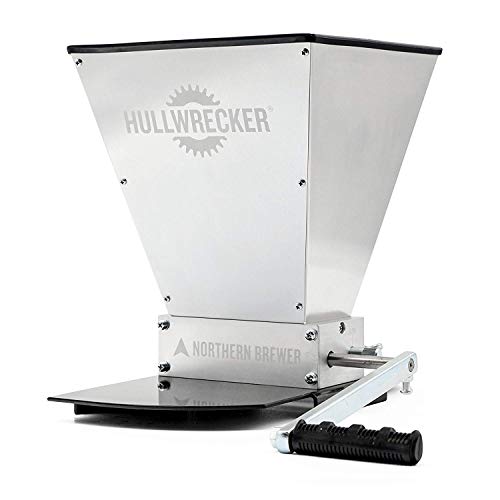
The Hullwrecker 2-Roller Grain Mill by Northern Brewer includes a metal base designed to fit standard 5- or 6.5-gallon buckets, reducing the need for an improvised base. It offers a fully adjustable roller gap from 0.025” to 0.1”, enabling precise control over crush to match your mash tun. The all-metal base contributes to sturdiness and long-term durability, making it a dependable option for consistent milling in homebrew setups. This mill emphasizes dependable performance and straightforward operation for brewers prioritizing repeatable crush results.
FERRODAY Malt Grain Mill Malt Stainless Steel 2 Roller
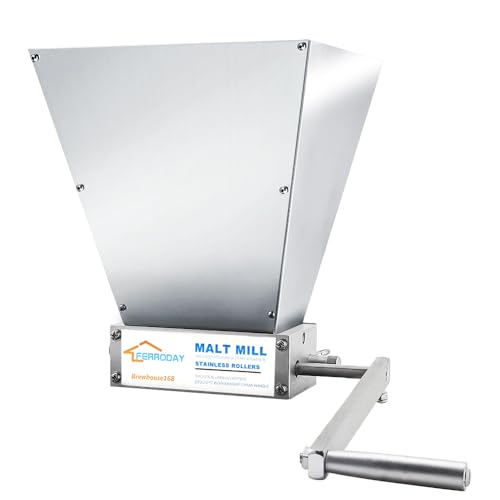
FERRODAY’s Malt Grain Mill combines stainless steel rollers with an aluminum alloy crank and hopper, offering corrosion resistance and robust durability. It features a 7.7 lb hopper and a 0.025–0.1 inch adjustable clearance, enabling precise crushing of malted barley and malted wheat while safeguarding hulls for sparging. The drill-ready option lets brewers increase throughput with a low-speed drill (not recommended for high RPM). This model emphasizes long-term reliability with materials chosen for heat and wear resistance, making it suitable for regular beer brewing cycles.
Buying Guide
- Crush precision: Look for an adjustable roller gap (commonly 0.025–0.1 inch) to tailor the crush for malt types and mash efficiency.
- Hopper capacity: Larger hoppers (7.7–15 lb) reduce refills during longer brews or multiple batches; consider batch size and frequency.
- Drill compatibility: Many mills offer a drill mode to accelerate milling. Use a low-speed drill to avoid damaging grains.
- Material and durability: Stainless steel rollers and sturdy bases improve longevity and ease of cleaning—important for beer quality and sanitation.
- Grain scope: Most mills are designed for malted barley and malted wheat; avoid models not suitable for corn, coffee beans, or sugarcane if you brew beer.
- Base stability: A solid, integrated base reduces movement during milling, contributing to safety and consistent grinding.
- Maintenance: Check for removable crank handles and easy disassembly for cleaning and maintenance to prevent husk damage or clogging.
- Noise and vibration: Drills can introduce more vibration; ensure your setup is secure and consider a rubber mat or stand for stability.
- Compatibility: If you use a stand mixer or a specific brewing setup, verify fitment and mounting options to integrate smoothly.
- Upgradability: Some models offer larger hoppers or higher-grade bearings—plan for future batch sizes if your brewing scale grows.
These options provide a balance of capacity, adjustment range, and ease of use for homebrewers evaluating efficient milling for beer production. When selecting, match your batch size, preferred milling method, and the type of grains you most often use to ensure you achieve consistent mashes and efficient extraction.